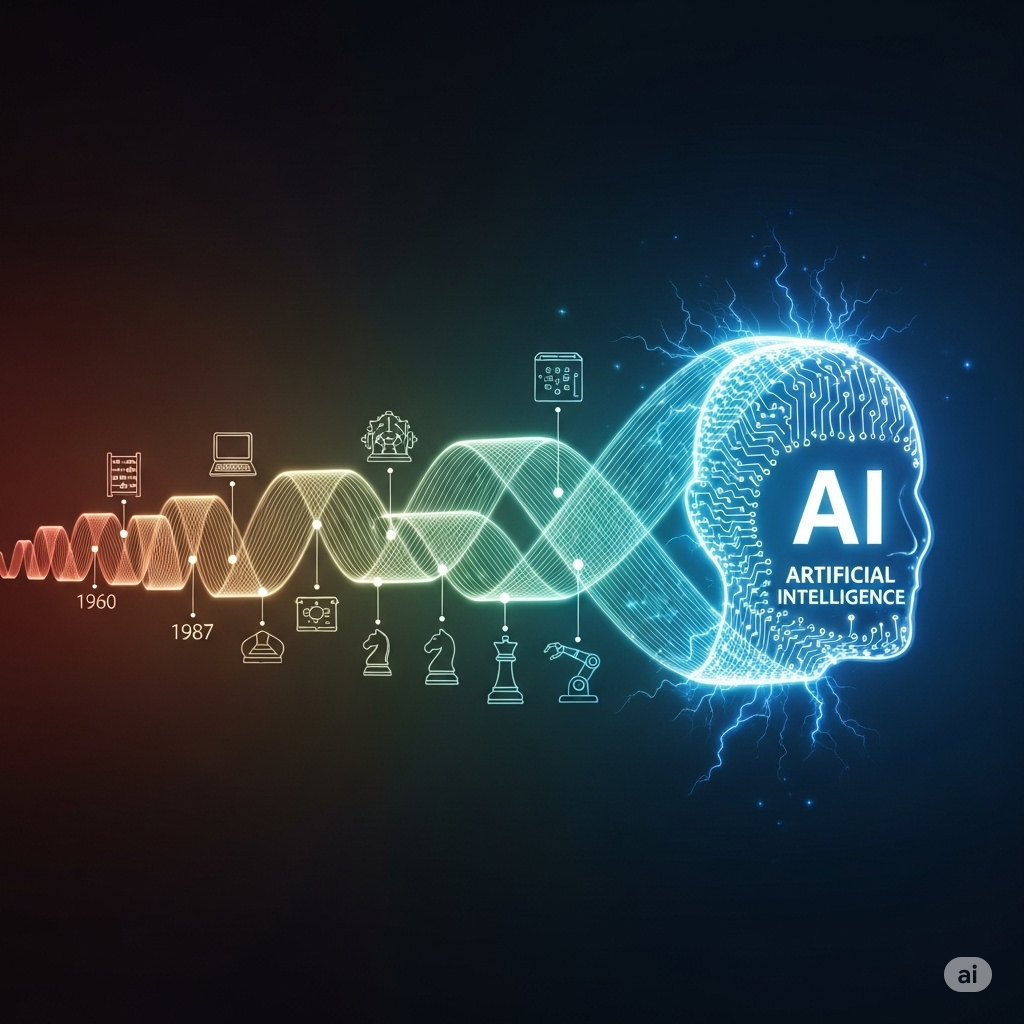
Artificial Intelligence (AI) has left the realm of science fiction to become an integral part of our daily lives, transforming industries and reshaping how we interact with the world. But this remarkable journey wasn’t an overnight phenomenon; it’s a culmination of decades of groundbreaking research, brilliant minds, and pivotal moments. Let’s take a tour through the most important milestones in AI history.
Early Concepts & Foundations: Laying the Theoretical Groundwork
Even before the term artificial intelligence emerged in the minds of researchers, visionaries were already thinking about the nature of intelligent machines. In 1950, Alan Turing introduced the ‘Turing test’ with his groundbreaking work ‘Computing Machinery and Intelligence’, a criterion for assessing the intelligence of machines that is still the subject of debate today [1]. At about the same time, Norbert Wiener’s work on cybernetics laid the foundations for understanding control and communication in both biological and artificial systems. These early theoretical investigations formed the philosophical and mathematical foundation on which AI was later built [2].
The Dartmouth Conference (1956): The Birth of a Field
The summer of 1956 at Dartmouth College marked the official birth of Artificial Intelligence as a distinct field of study. Organized by John McCarthy, Marvin Minsky, Nathaniel Rochester, and Claude Shannon, this workshop brought together leading researchers and formally proposed the term “Artificial Intelligence.” It was here that the bold goal of creating machines that could “think” was formally articulated, setting the agenda for decades of research. [3]
Early AI Programs: First Steps Towards Intelligence
The enthusiasm of Dartmouth quickly led to the development of some of the first AI programs. Allen Newell and Herbert A. Simon’s Logic Theorist (1956) was a pioneering program capable of proving mathematical theorems, demonstrating the power of symbolic AI. Later, Joseph Weizenbaum’s ELIZA (1966) captivated users with its ability to simulate conversational therapy, highlighting the potential for natural language processing, even if its understanding was superficial. These programs, while limited, provided tangible proof that machines could exhibit intelligent behaviors. [4]
AI Winters: Periods of Disillusionment
The initial euphoria surrounding AI was eventually met with harsh realities. The difficulty of achieving human-level intelligence and the limitations of early approaches led to periods of reduced funding and public skepticism known as “AI Winters.” These periods, particularly in the mid-1970s and late 1980s, served as crucial learning experiences, forcing researchers to re-evaluate methodologies and set more realistic expectations. [5]
Expert Systems: Applied Knowledge
The 1980s saw a resurgence of AI with the rise of Expert Systems. These programs, like MYCIN, were designed to mimic the decision-making abilities of human experts in specific domains by encoding large amounts of domain-specific knowledge. While successful in narrow applications, their brittleness and difficulty in scaling exposed the limitations of purely rule-based AI. [6]
Connectionism and Neural Networks: Learning from Data
Parallel to symbolic AI, the concept of Connectionism and Neural Networks began to gain traction. Inspired by the human brain, these networks learn from data by adjusting the strengths of connections between “neurons.” The development of the backpropagation algorithm (1986) by researchers like David Rumelhart, Geoffrey Hinton, and Ronald Williams provided an efficient way to train multi-layered neural networks, paving the way for future breakthroughs. [7]
Machine Learning Breakthroughs: The Rise of Data-Driven AI
The 1990s and early 2000s witnessed significant advancements in Machine Learning (ML), a subfield of AI focused on enabling systems to learn from data without explicit programming. Algorithms like Decision Trees and Support Vector Machines (SVMs) proved highly effective for tasks like classification and regression, demonstrating the power of data-driven approaches and setting the stage for the big data era. [8]
Deep Learning Revolution: Unleashing Neural Network Potential
The 2010s ushered in the Deep Learning Revolution. Thanks to increased computational power, vast datasets, and refined algorithms, deep neural networks with many layers achieved unprecedented performance. AlexNet’s victory in the 2012 ImageNet competition, significantly outperforming traditional computer vision methods, marked a turning point. Later, AlphaGo’s defeat of the world’s best Go player in 2016 showcased deep learning’s ability to master complex strategic games, captivating the world’s attention. [9]
Rise of Generative AI: Creating the Unseen
Most recently, we’ve witnessed the astonishing rise of Generative AI. Models like Generative Adversarial Networks (GANs), introduced by Ian Goodfellow in 2014, can create realistic images, audio, and data. Even more impactful have been Transformer architectures, exemplified by OpenAI’s GPT series. These large language models are capable of generating coherent and contextually relevant text, code, and even creative content, pushing the boundaries of what AI can produce and hinting at a future where AI is not just intelligent, but also inherently creative. [10]
Final thought
AI has come a long way thanks to smart people who never gave up on their ideas. From big theories to inventions that changed the world, AI’s story shows what humans can achieve. Now that we’re about to see even bigger breakthroughs, it’s important to know how we got here. This helps us understand AI’s amazing journey and what it might do for us next.
Have I forgotten a key milestone? Please feel free to contact me.
Weblinks & References
During my research, I kept coming across the standard work Arificial Intelligence – A Modern Approach [5] – knowing full well that crucial years from 2010 onwards are missing here.
[1] Turing, A. M. (1950). Computing Machinery and Intelligence. Mind, 59:433-460.
[2] N. Wiener (1948), Cybernetics, Wiley, New York.
[3] McCarthy, J., Minsky, M., Rochester, N., Shannon, C.E. (1955) A Proposal for the Dartmouth Summer Research Project on Artificial Intelligence
[4] Newell, A., Shaw, J.C., Simon, H. A. (1957). Empirical explorations of the Logic Theory Machine: A case study in heuristics. Proceedings of the Western Joint Computer Conference, 11, 218-230.
[5] Russell, S. J., & Norvig, P. (2009). Artificial Intelligence: A Modern Approach (3rd ed.). Prentice Hall. (Chapter 1, “Introduction”).
[6] Feigenbaum, Edward A. (1977). The art of artificial intelligence: Themes and case studies of knowledge engineering. Proceedings of the 5th International Joint Conference on Artificial Intelligence (IJCAI-77), 1014-1029.
[7] Rumelhart, D. E., Hinton, G. E., & Williams, R. J. (1986). Learning representations by back-propagating errors. Nature, 323(6088), 533-536.
[8] Cortes, C., & Vapnik, V. (1995). Support-Vector Networks. Machine Learning, 20(3), 273-297.
[9] Krizhevsky, A., Sutskever, I., & Hinton, G. E. (2012). ImageNet Classification with Deep Convolutional Neural Networks. Advances in Neural Information Processing Systems (NIPS 2012), 25, 1097-1105.
[10] Goodfellow, I., Pouget-Abadie, J., Mirza, M., Xu, B., Warde-Farley, D., Ozair, S., … & Bengio, Y. (2014). Generative Adversarial Nets. Advances in Neural Information Processing Systems (NIPS 2014), 27.